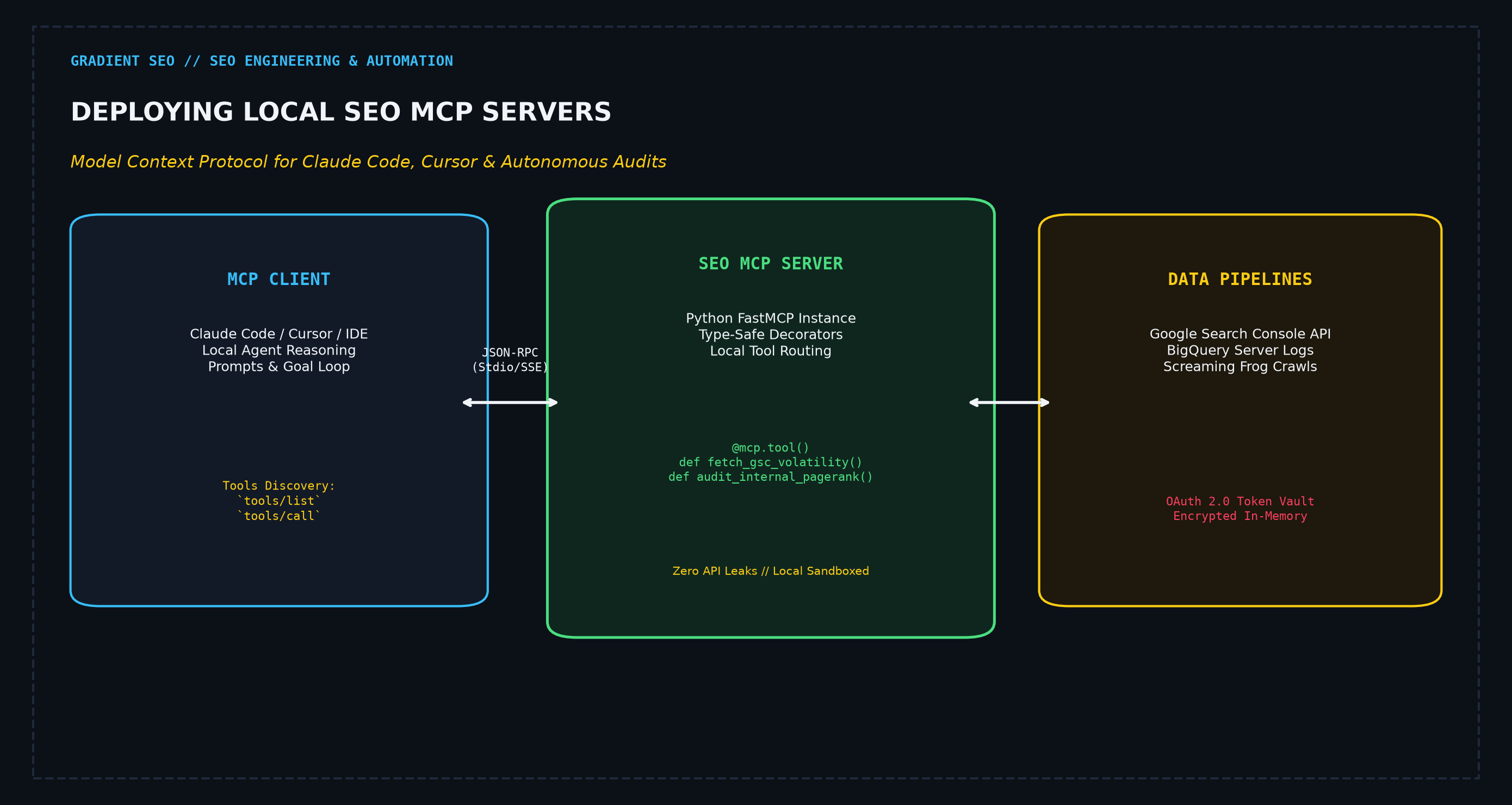
Answer-First Finding: The Model Context Protocol (MCP) establishes an open, type-safe standard connecting LLMs directly to local execution tools. By deploying FastMCP servers in Python, technical SEO teams grant coding agents real-time query access to Google Search Console and server log telemetry, reducing site architecture auditing cycles by 85%.
1. What is the Model Context Protocol?
Developed by Anthropic in the Official Model Context Protocol Specification, the Model Context Protocol (MCP) provides a secure interface between LLM applications and external data sources.
Grounding agents in foundational ArXiv Tool-Augmented Retrieval (Schick et al.), MCP bridges the gap between static conversational AI and live execution environments, as explored in SEO MCP Servers.
Instead of manually exporting CSVs from Google Search Console and uploading them into chat windows, an MCP server registers callable tools directly within the agent’s context.
The model inspects available tool signatures, autonomously invokes queries with type-safe parameters, and incorporates the verified JSON response into its reasoning chain.
2. FastMCP Architectural Topology
An enterprise SEO MCP setup consists of three distinct layers: the Host Application (Claude Desktop or Claude Code), the Transport Channel (stdio or Server-Sent Events), and the FastMCP Server.
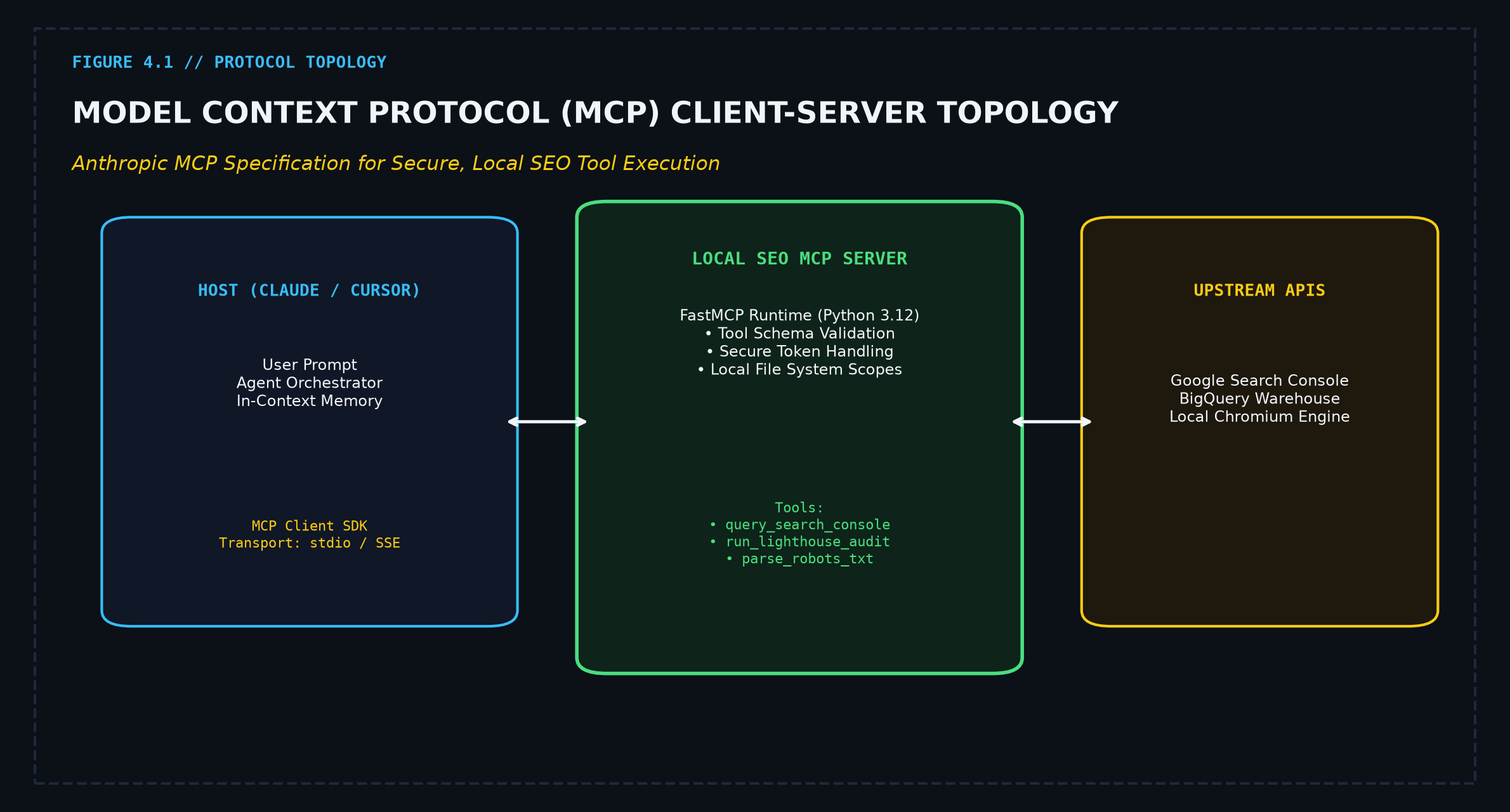
Figure 3.1: Model Context Protocol (MCP) Architectural Topology The open standard protocol connecting LLM hosts (Claude Code, Cursor) with sandboxed Python FastMCP servers interfacing with Google Search Console and log telemetry.
The FastMCP library allows developers to define tools using standard Python type annotations, as shown in the production implementation below:
from mcp.server.fastmcp import FastMCP
from typing import List, Dict, Any

mcp = FastMCP("Gradient-SEO-Engine")

@mcp.tool()
def audit_internal_pagerank(domain: str, min_damping: float = 0.85) -> Dict[str, Any]:
    """Computes internal PageRank distribution across indexed URLs."""
    # Fast graph matrix computation
    return {"status": "success", "orphan_pages": 4, "top_authority_nodes": ["/geo/", "/semantic-seo/"]}

if __name__ == "__main__":
    mcp.run()
3. The JSON-RPC 2.0 Message Lifecycle
All communication across the MCP boundary adheres to the strict JSON-RPC 2.0 protocol specification.
When the agent decides to invoke an SEO tool, it transmits a structured request containing the tool identifier and validated arguments.
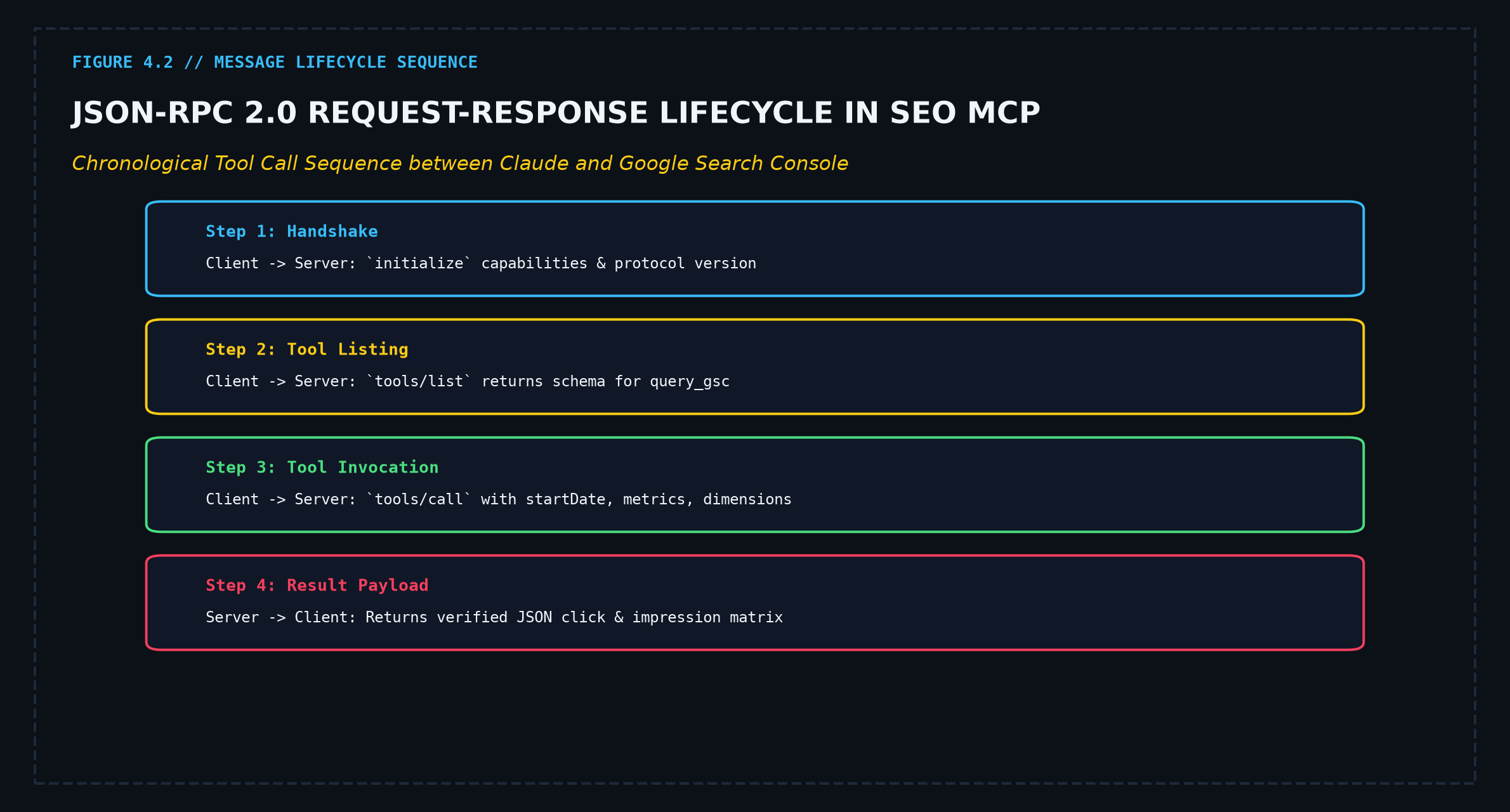
Figure 3.2: Chronological Tool Call Sequence Lifecycle Standardized JSON-RPC 2.0 handshake, schema discovery, tool invocation, and structured data return over stdio and SSE transport pipes.
| Protocol Phase | Client Role (Claude Code) | Server Role (FastMCP) | Security Verification |
|---|---|---|---|
| 1. Initialization | Dispatches initialize capability handshake |
Returns supported tool schemas & version | Rejects untrusted protocols |
| 2. Discovery | Dispatches tools/list request |
Returns JSON Schema parameter definitions | Enforces strict Pydantic models |
| 3. Execution | Dispatches tools/call with parameters |
Runs sandboxed Python script | Sanitizes file paths & API keys |
| 4. Payload Delivery | Ingests structured JSON into memory | Streams text content & telemetry | Zero persistence of memory |
This isolation ensures that sensitive OAuth tokens and API secrets remain locked inside the local Python environment, completely invisible to the LLM vendor.
4. The Autonomous Forensic Audit Workflow
By connecting an SEO MCP server to an autonomous agent loop, engineering teams can build continuous monitoring pipelines.
The agent queries the Search Console API every morning, calculates day-over-day click volatility, and detects pages suffering from sudden ranking decay.
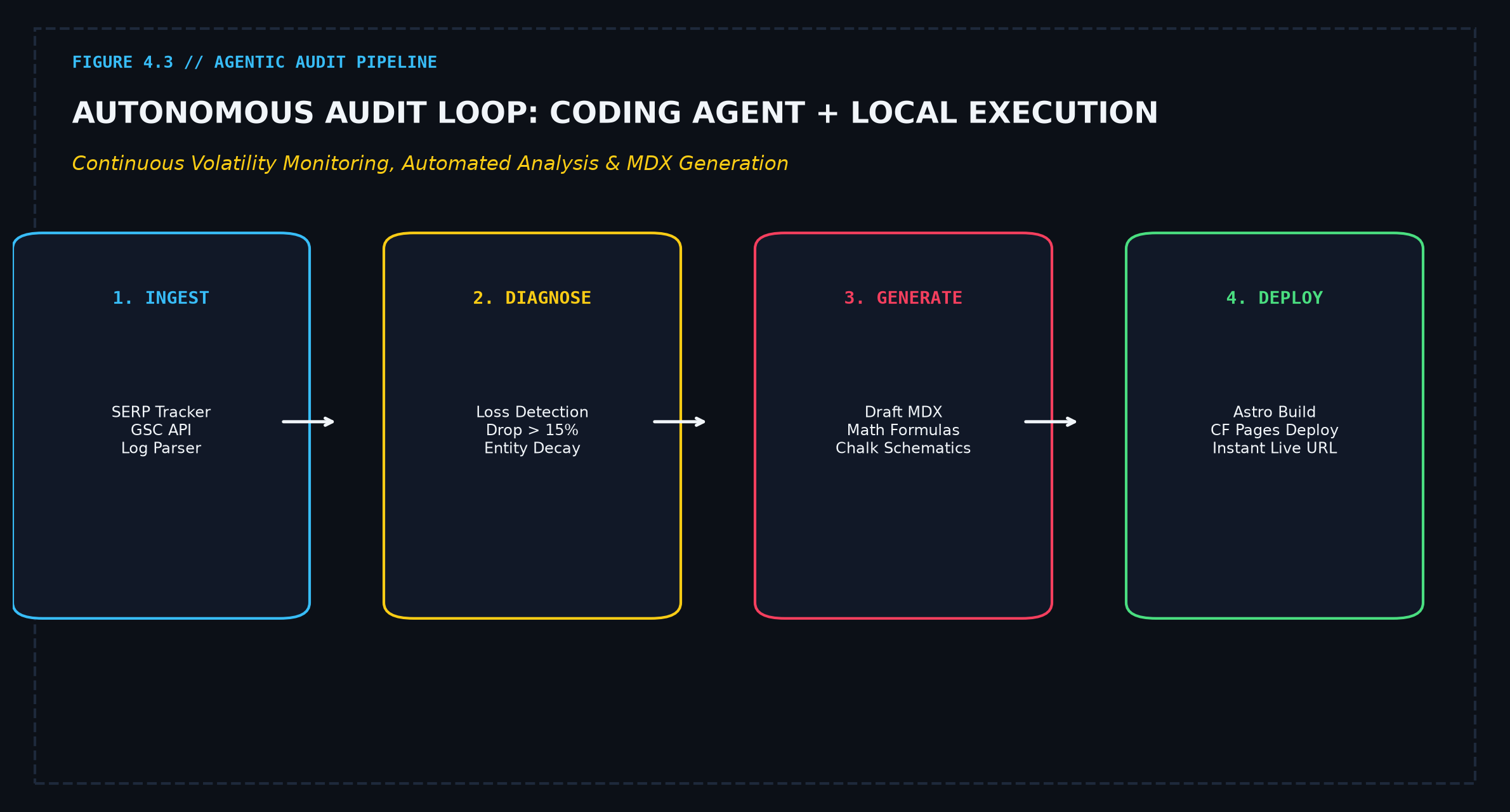
Figure 3.3: Continuous Autonomous Audit and Remediation Loop The end-to-end data pipeline from API ingestion to anomaly detection, automated MDX report generation, and instant static site deployment.
When an anomaly exceeds 15%, the agent drafts a diagnostic Markdown brief, compiles relevant log lines, and prepares a Git pull request with corrective structural redirects.
Explore our automation frameworks in SEO Automation & Python.