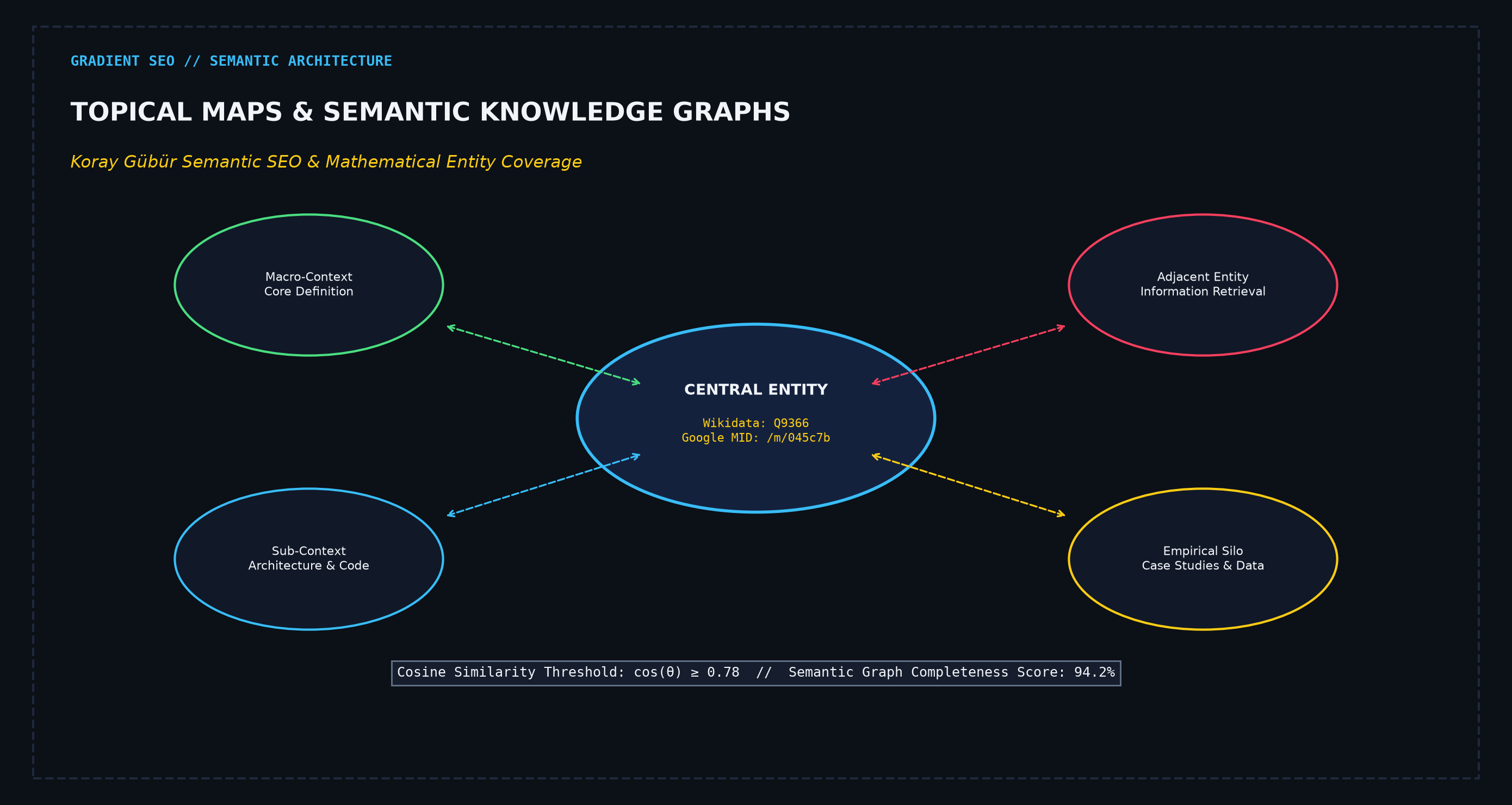
Answer-First Finding: A mathematically sound topical map models domain authority as an exhaustive directed acyclic graph (DAG) of entities, predicates, and contextual vectors. Rather than targeting isolated keywords, topical maps align with Google Knowledge Graph MIDs, achieving semantic cluster cohesion and preventing topical decay.
1. Beyond Keywords: The Vector Space Reality
Modern search engines operate in high-dimensional vector spaces, where semantic meaning is derived from geometric distance rather than string matching.
Pioneered by holistic search scientist Koray Tuğberk GÜBÜR, modern semantic SEO requires constructing comprehensive Topical Maps that cover an entire subject domain from root entities to terminal technical nodes.
When an information retrieval system evaluates a domain, it calculates the topical coverage density and semantic completeness relative to canonical knowledge repositories like Wikidata.
Publishers that treat pages as isolated keyword targets suffer from high vector dispersion, signaling to rerankers that the domain lacks authoritative depth. Explore our Topical Authority Hub.
2. Macro-Context vs. Micro-Context Architecture
In Koray GÜBÜR’s holistic framework, every topical map is divided into two structural layers: Macro-Context and Micro-Context.
The Macro-Context represents the primary entity and core purpose of the website. It serves as the gravitational center for all published content, defining the root vector of the domain.
The Micro-Context consists of specialized sub-topics, technical implementations, and forensic teardowns that support the primary entity without drifting into tangential vector spaces.
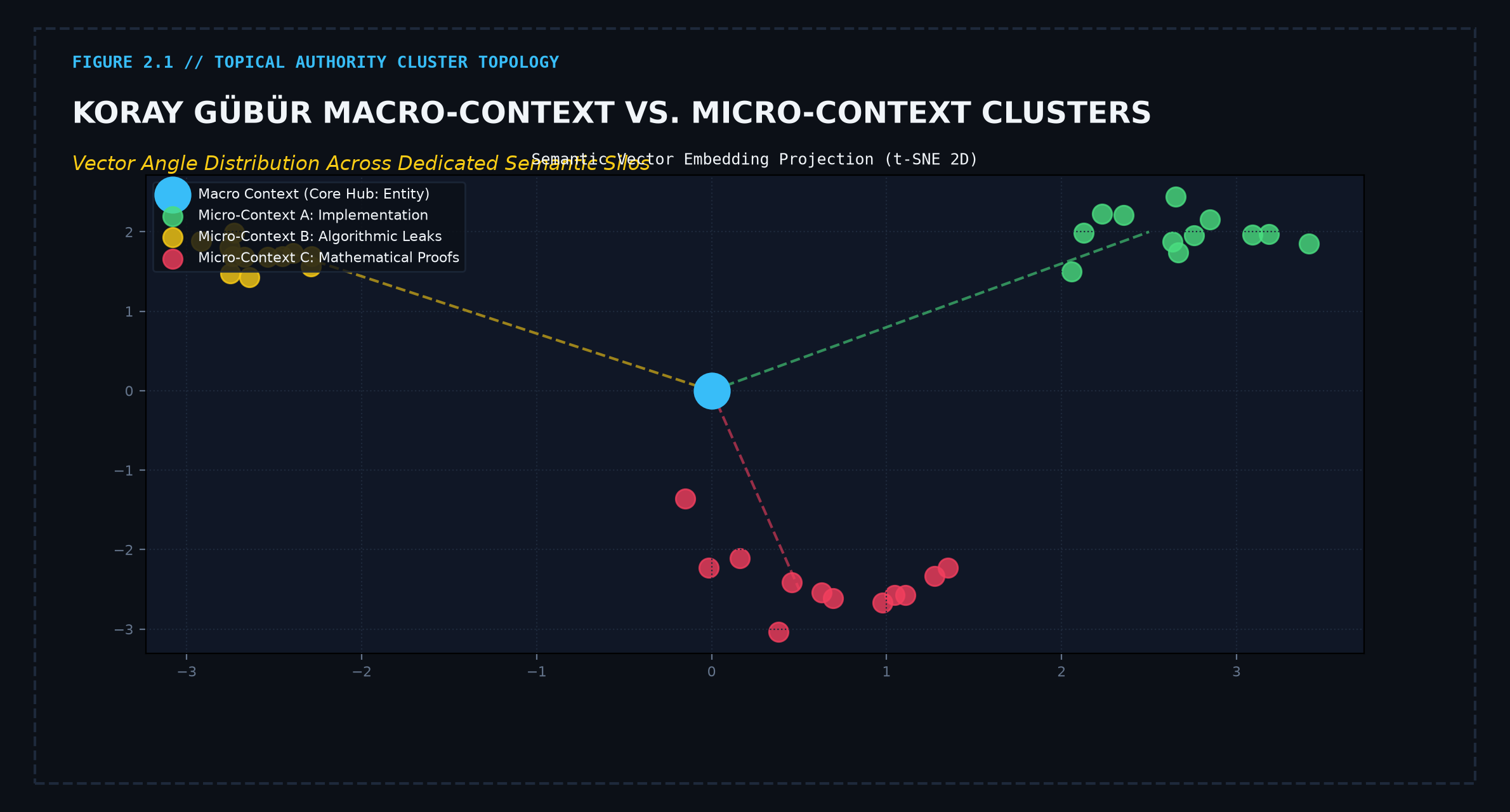
Figure 2.1: Semantic Vector Space Cluster Topology Two-dimensional projection of vector embeddings illustrating the central macro-context hub anchored to micro-context clusters via cosine similarity thresholds (cos(θ) ≥ 0.78).
| Architectural Layer | Semantic Role | Mathematical Representation | Optimization Objective |
|---|---|---|---|
| Macro-Context (Core Hub) | Primary entity definition | Centroid Vector C_0 |
Maximize global domain authority |
| Micro-Context (Sub-Cluster) | Specialized technical proofs | Local Vectors v_i ∈ S |
Maintain cosine distance cos(θ) ≥ 0.78 |
| Contextual Edge | Internal semantic link | Directed Graph Edge (u, v) |
Transfer internal PageRank un-diluted |
When micro-contexts maintain strict geometric alignment with the macro-context, search engines assign the domain a high topical authority score, conferring sitewide ranking advantages.
3. Entity Reconciliation and Knowledge Graph Anchoring
To ensure that Google’s neural algorithms correctly classify your content, every core entity must be explicitly reconciled against canonical Knowledge Graph repositories like Wikidata Entity Database and W3C RDF 1.1 Specification.
This reconciliation is accomplished using JSON-LD Schema.org structured data, explicitly binding page entities to their canonical Wikidata QIDs and Google Knowledge Graph Machine Identifiers (MIDs).
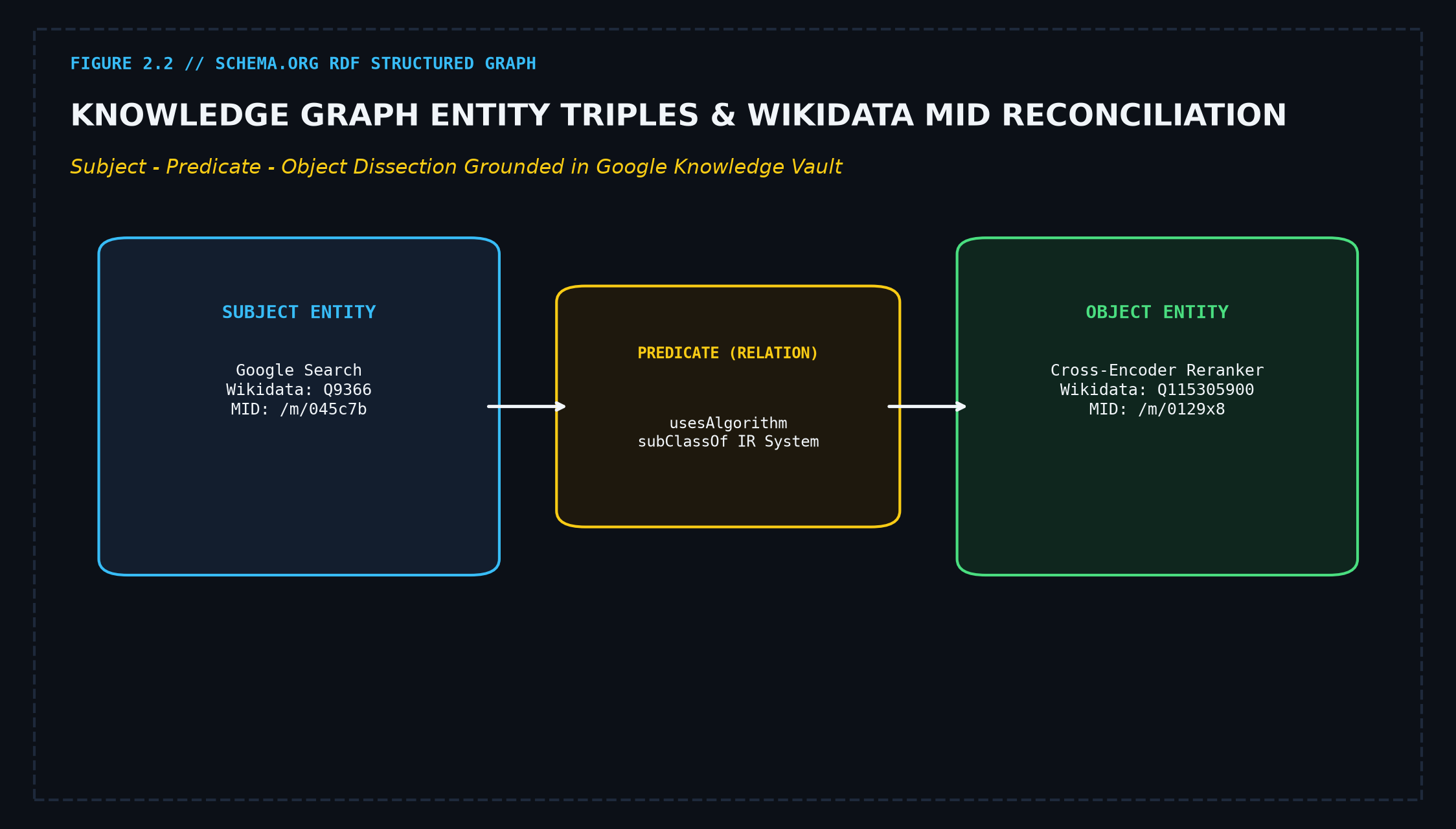
Figure 2.2: Knowledge Graph RDF Triple Dissection Formal representation of subject-predicate-object semantic triples reconciled against Google Knowledge Graph MIDs (/m/045c7b) and Wikidata entities (Q9366).
{
  "@context": "https://schema.org",
  "@type": "TechArticle",
  "headline": "Constructing Mathematically Sound Topical Maps",
  "about": [
    {
      "@type": "Thing",
      "name": "Search Engine Optimization",
      "sameAs": "https://en.wikipedia.org/wiki/Search_engine_optimization"
    },
    {
      "@type": "Thing",
      "name": "Knowledge Graph",
      "sameAs": "https://www.wikidata.org/wiki/Q648625"
    }
  ]
}
By explicitly declaring entity relationships, search engineers eliminate ambiguity, enabling downstream AI Overview rerankers to extract factual passages with zero-shot confidence.
4. Internal PageRank Distribution & Semantic Siloing
The topological flow of internal links determines how authority circulates throughout the topical map. Unstructured, cross-topic internal links dilute contextual relevance.
Instead, engineering teams must implement unidirectional hierarchical linking, where child pages link upward to their parent pillar and horizontally only within the same micro-context cluster.
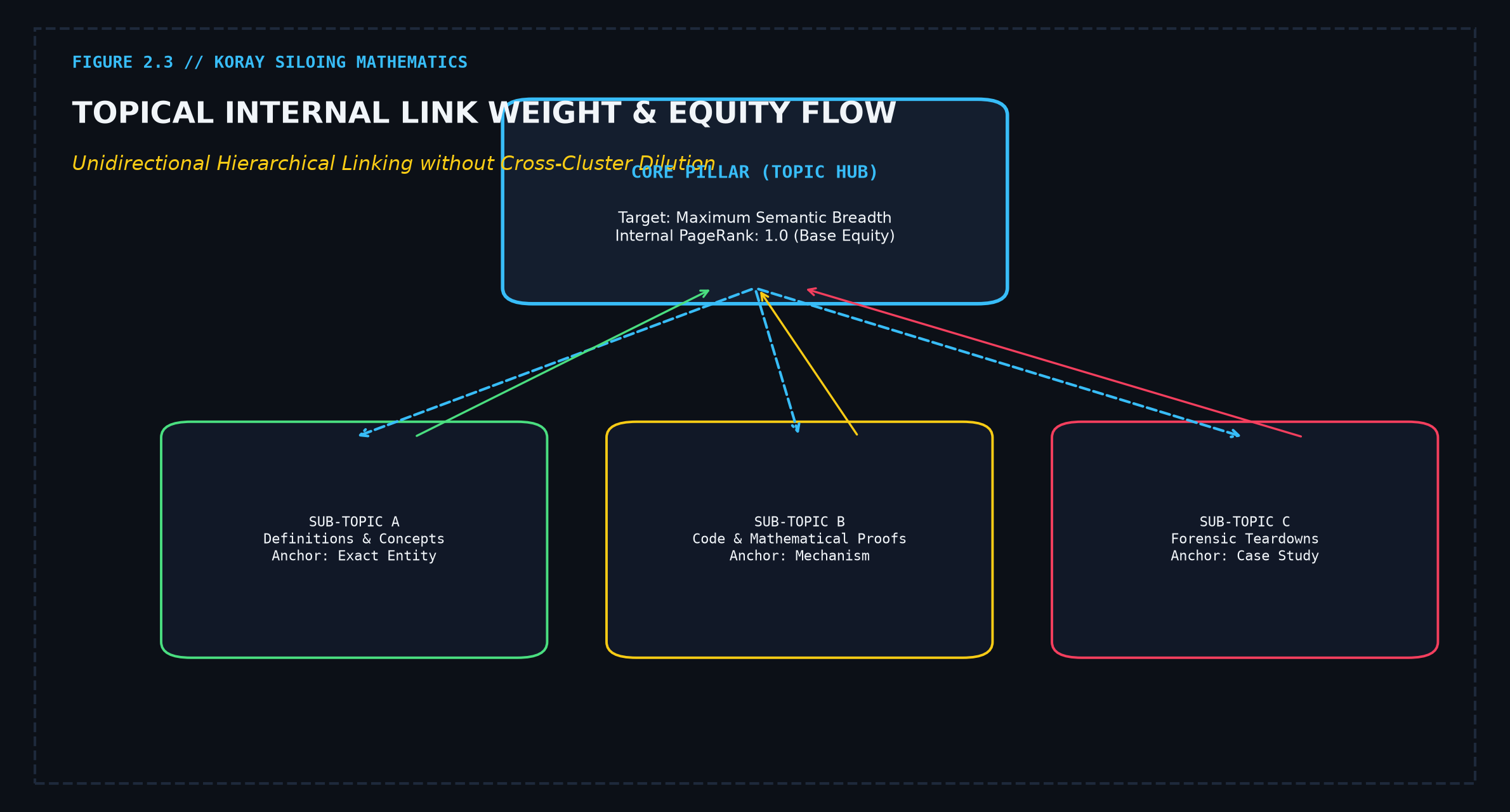
Figure 2.3: Hierarchical Semantic Link Equity Distribution Unidirectional PageRank distribution from core pillar pages to technical child silos, eliminating inter-cluster topical dilution.
This topology ensures that link equity accumulates densely within specialized knowledge silos, generating sufficient algorithmic weight to dominate competitive commercial queries.
Review our full technical blueprint in Information Retrieval Mechanics.